

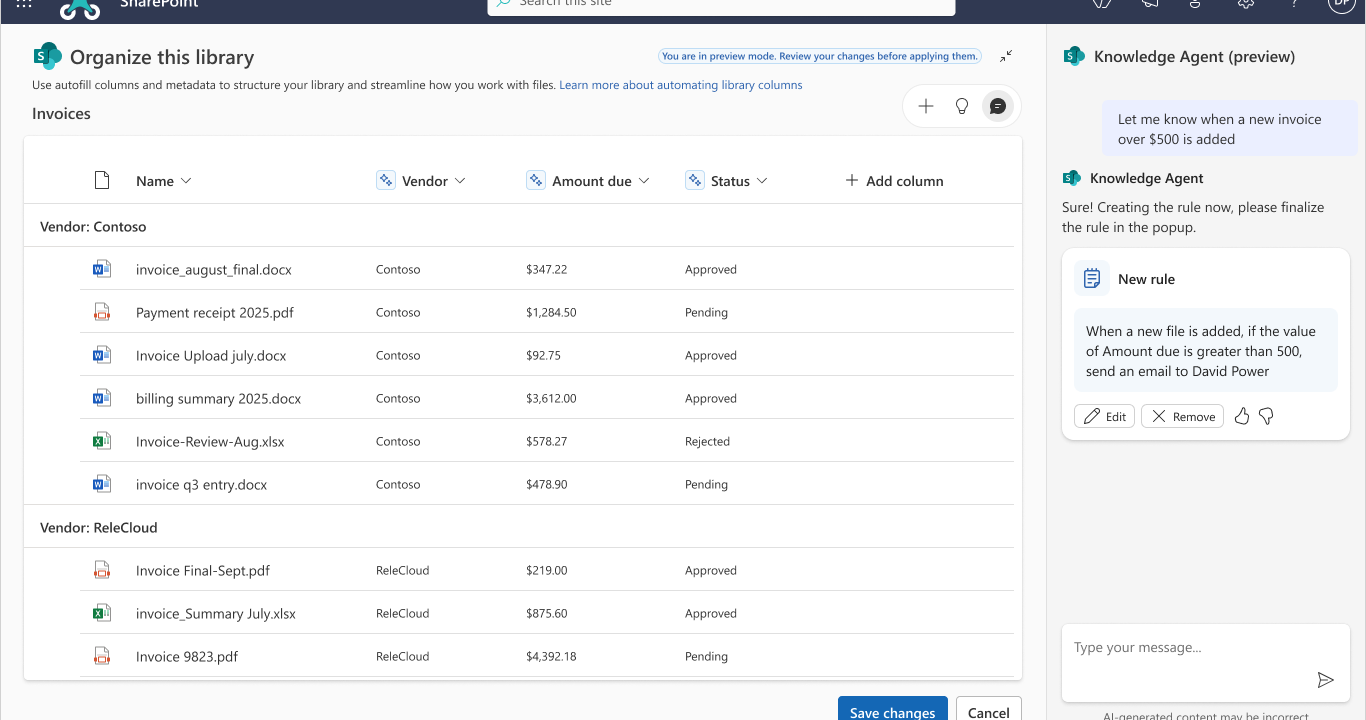
Knowledge agents are only as good as the information they can access, understand, and trust. Even the most advanced AI agent will fail if enterprise content is poorly labeled, insecurely permissioned, outdated, duplicated, or low quality.
For businesses building AI-powered search, copilots, or internal knowledge assistants, three foundations matter most: metadata, permissions, and content quality. Together, they determine whether a knowledge agent gives the right answer, to the right person, at the right time.
What Is a Knowledge Agent?
A knowledge agent is an AI system that helps users find, summarize, reason over, and act on organizational knowledge. It may search documents, wikis, tickets, emails, policies, meeting notes, product specs, or customer records.
Unlike a simple chatbot, a knowledge agent needs context. It must know what a document is about, who can access it, whether it is current, and whether it is trustworthy. That is where metadata, permissions, and content quality become critical.
Why Metadata Matters for Knowledge Agents
Metadata is information about information. It includes details like author, department, document type, creation date, topic, customer name, product area, region, sensitivity level, and version.
Without metadata, a knowledge agent sees a messy pile of content. With metadata, it can filter, rank, and retrieve information more intelligently.
| Metadata Type | Why It Matters | Example |
|---|---|---|
| Document type | Helps the agent understand intent | Policy, FAQ, contract, meeting note |
| Date/version | Prevents outdated answers | “Use the latest pricing sheet only” |
| Owner/author | Improves accountability | HR owns benefits policy |
| Topic/product | Improves search relevance | Billing, onboarding, security |
| Sensitivity label | Supports safe access | Confidential, internal, public |
Good metadata improves retrieval accuracy. For example, if a user asks, “What is our refund policy for enterprise customers?” the agent should prioritize current policy documents, customer success playbooks, and legal-approved terms instead of old Slack messages or draft documents.
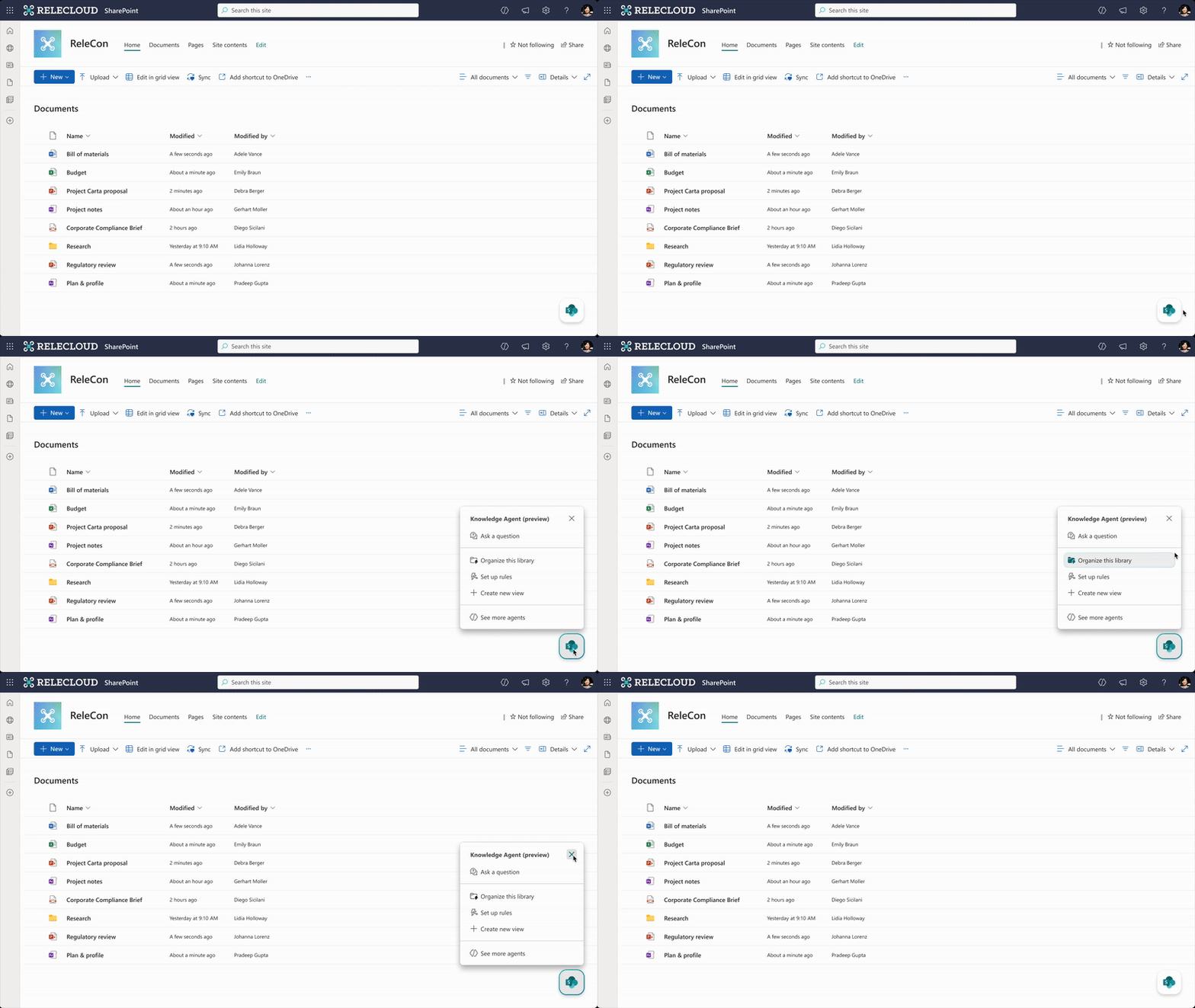
Why Permissions Matter for Knowledge Agents
Permissions decide who can see what. For knowledge agents, this is not optional. It is a security requirement.
If an AI agent ignores access controls, it may expose confidential financial data, HR records, customer contracts, legal documents, or executive strategy. That creates compliance, privacy, and trust risks.
A reliable knowledge agent must follow the same permission rules as the underlying systems. If a user cannot access a document in Google Drive, SharePoint, Notion, Confluence, Salesforce, or another knowledge source, the agent should not use that document to answer the user.
Permissions affect three things:
- Security: Prevents unauthorized access to sensitive information.
- Trust: Employees are more likely to use an agent that respects access boundaries.
- Compliance: Supports privacy, legal, and regulatory requirements.
In enterprise AI, “better answers” cannot come at the cost of data leakage.
Why Content Quality Matters for Knowledge Agents
Content quality determines whether the agent has reliable material to work with. If the source content is inaccurate, duplicated, incomplete, or outdated, the agent may produce confident but wrong answers.
Common content quality problems include:
| Content Problem | Impact on Knowledge Agents | Fix |
|---|---|---|
| Outdated documents | Agent gives old policies or pricing | Add review cycles and expiration dates |
| Duplicate content | Agent returns conflicting answers | Consolidate and archive duplicates |
| Unclear ownership | No one maintains the source | Assign content owners |
| Poor formatting | Agent misses key details | Use structured headings and tables |
| Missing context | Agent gives incomplete answers | Add summaries, definitions, and examples |
High-quality content makes AI answers more accurate, explainable, and useful. It also reduces hallucination risk because the agent has clearer, more authoritative sources to ground its responses.
How These Three Factors Work Together
Metadata, permissions, and content quality are connected. A knowledge agent needs all three to perform well.
| Foundation | Main Role | If Missing |
|---|---|---|
| Metadata | Helps the agent find and rank the right content | Search becomes noisy and irrelevant |
| Permissions | Controls what the agent can safely access | Sensitive data may be exposed |
| Content quality | Ensures answers are accurate and useful | The agent may produce wrong or outdated answers |
Think of it this way: metadata helps the agent understand the content, permissions help it respect boundaries, and content quality helps it answer correctly.
Best Practices for Building Reliable Knowledge Agents
To make knowledge agents effective, organizations should prepare their knowledge base before scaling AI across teams.
Start with these steps:
- Create a metadata standard: Define required fields like owner, department, topic, document type, sensitivity, and last reviewed date.
- Audit permissions: Make sure access controls are accurate across systems before connecting them to an AI agent.
- Identify authoritative sources: Mark approved policies, playbooks, FAQs, and documentation as trusted sources.
- Remove outdated content: Archive old files, drafts, and duplicates that may confuse the agent.
- Assign content owners: Every important knowledge asset should have someone responsible for keeping it current.
- Use structured formats: Headings, summaries, tables, and clear labels help agents retrieve better answers.
- Review agent outputs: Track failed answers, missing sources, and conflicting responses to improve the knowledge base over time.
Knowledge agents do not become useful simply because they are powered by AI. They become useful when they are connected to well-organized, secure, and trustworthy knowledge.
Metadata improves discovery. Permissions protect sensitive information. Content quality ensures accurate answers. Together, they form the foundation for reliable enterprise AI.
Organizations that invest in these foundations will build knowledge agents that employees can actually trust, adopt, and use every day.
CTA: If you are planning to deploy a knowledge agent, start by auditing your metadata, permissions, and content quality before expanding AI access across the business.

Adnan, a distinguished professional, boasts an impressive track record as a Microsoft MVP, having achieved this prestigious recognition for the eighth consecutive year since 2015. With an extensive career spanning over 18 years, Adnan has honed his expertise in various domains, notably excelling in SharePoint, Microsoft 365, Microsoft Teams, the .Net Platform, and Microsoft BI. Presently, he holds the esteemed position of Senior Microsoft Consultant at Olive + Goose.Notably, Adnan served as the MCT Regional Lead for the Pakistan Chapter from 2012 to 2017, showcasing his leadership and commitment to fostering growth within the tech community. His journey in the realm of SharePoint spans 14 years, during which he has undertaken diverse projects involving both intranet and internet solutions for both private and government sectors. His impact has transcended geographical boundaries, leaving a mark on projects in the United States and the Gulf region, often collaborating with Fortune 500 companies.Beyond his roles, Adnan is a dedicated educator, sharing his insights and knowledge as a trainer. He also passionately advocates for technology, frequently engaging with the community through speaking engagements in various forums. His multifaceted contributions exemplify his dedication to the tech field and his role in driving its evolution.




No Comments